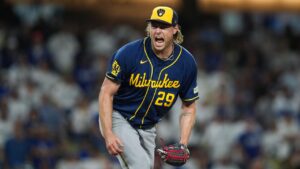
With the Milwaukee Brewers winning the World Series in dominant fashion after a 103-win regular season, 29 other teams will be thinking about what they can learn from this year’s Brew Crew.
It’s unavoidable to look at the new champions and try to find lessons to take away, particularly when they were MLB’s best team from start to finish rather than a good club that got hot at the perfect time. Replicating a worthy champ’s formula isn’t always possible, though, and some caution is required when it comes to copying any great team’s blueprint.
Below are a few lessons MLB clubs can take from the 2026 Brewers, and features of the team’s run that aren’t likely to be applicable to rival front offices looking to earn championships of their own.
Managers still matter
In recent years, plenty of ink has been spilled about how much MLB managers matter and whether they are becoming mere middle managers in a world where front offices play a notable role in on-field decision-making.
Staking out a strong position on the importance of managers requires embracing some ambiguity. Definitive answers about their importance are elusive. Even so, once in a while, evidence of a skipper having a notable impact on his team’s success is tough to ignore.
Enter Pat Murphy. The pocket pancake pioneer has won two Manager of the Year Awards in three full seasons as Milwaukee’s skipper and guided his team to a World Series title that required him to deploy his bullpen for 65 of the club’s 118 innings.
During his three years in Milwaukee, Murphy has been extremely active calling for steals of second and third, sac bunts, intentional walks and pinch runners between 17 and 43 per cent more than league average. Although that isn’t always a good thing in a vacuum, he’s had a lot of success with high-volume shot calling. His successful challenge rate also ranks fifth-highest among active managers at 59.7 per cent. In each of the past two years, it’s been over 70 per cent.
It’s hard to know exactly how well a Brewers roster with the same talent would have fared without Murphy, but most evidence suggests he’s good at pushing the right buttons. Most managers stick relatively close to sabermetrically influenced conventional wisdom, and the gap between them has likely narrowed in recent years. That doesn’t mean it’s impossible to find a standout who moves the needle.
Spending money still matters ... even if the Brewers had a cheap roster
Just because the Brewers won the World Series with MLB’s 19th-highest payroll — in a matchup with the 28th-ranked Tampa Bay Rays — it doesn’t mean that the correlation between spending big on players has evaporated.
Both Milwaukee and Tampa Bay deserve credit for succeeding despite their financial constraints, but the last 10 World Series matchups before 2026 show a steady pattern of big spenders participating in the Fall Classic.
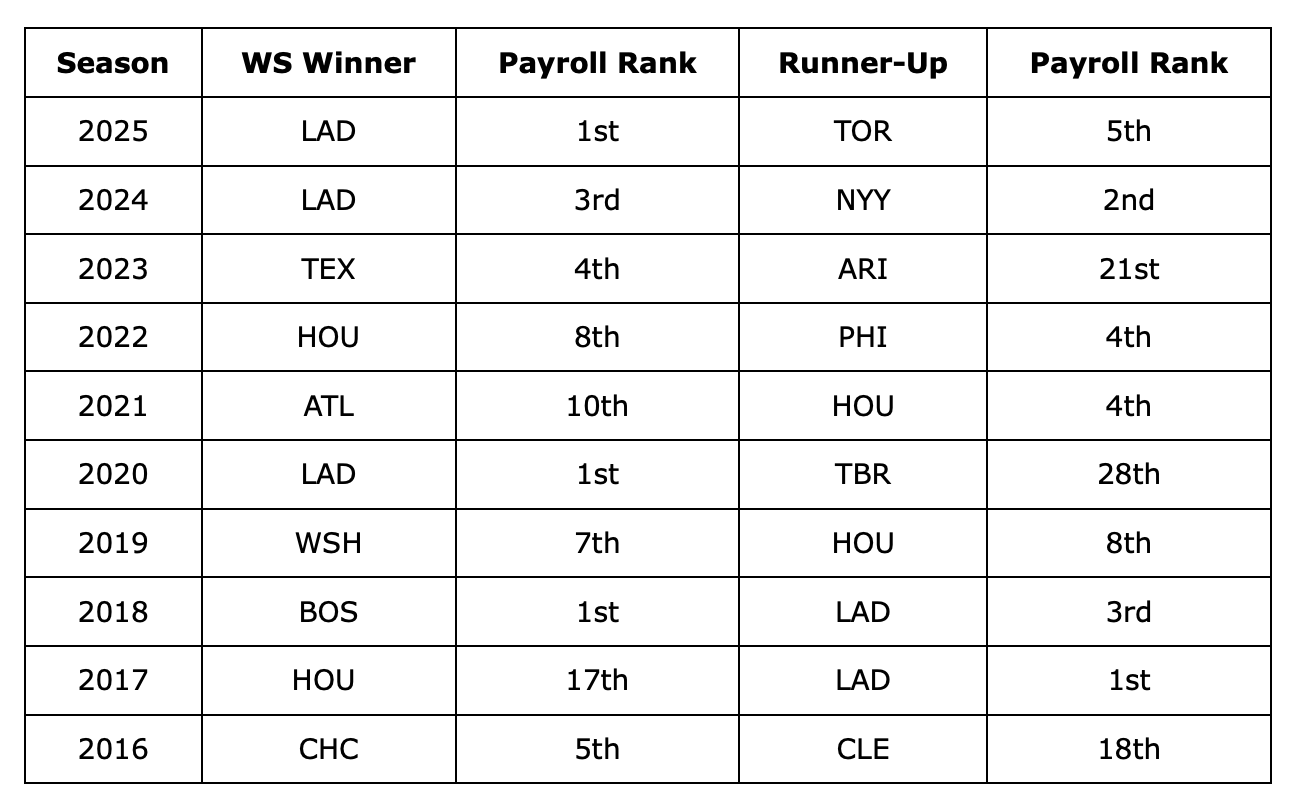
There’s some variance here, but teams with more expensive rosters have had an easier time breaking through than spendthrift franchises lately. The Brewers built an incredible team that dominated from April through October without many pricey veterans. That’s commendable, and they should be considered a notable example of smart team-building trumping financial muscle. It doesn’t mean their success invalidates the importance of spending — at least under MLB’s current structure.
Bottoming out isn't a necessary component of the competitive cycle
Tanking isn’t as much of a concern in baseball as it is in some other sports, due to the time it takes top draft picks to make an impact. Still, gutting a big-league roster and spending time losing to help access the blue-chip talent can seem like an appealing path for certain teams.
These Brewers show that stepping back isn’t a prerequisite for building a winning core. Milwaukee hasn’t had a full losing season since 2016. Its World Series roster included just two players drafted in the top-15 picks of the MLB Draft: Sal Frelick, who went 15th overall in 2021, and Andrew Vaughn (third overall in 2019), a complementary bat who made just 10 plate appearances during the post-season. Milwaukee’s biggest stars this season were Brice Turang (a 21st-overall pick), Jackson Churio (an international free agent who signed for a relatively modest $1.8 million) and Jacob Misiorowski (who the Brewers stole with the 66th-overall selection four years ago).
Finding that trio, and other key pieces Frelick, Garrett Mitchell and Cooper Pratt wasn’t the result of attaining rarefied draft capital through painful losing seasons or trading away established stars. The Brewers showed they could find and develop impact players without any of the advantages losing can bring in the pursuit of young talent.
Milwaukee's pitching was unbelievable but dominating in one facet of the game doesn't guarantee a title
The easy narrative of the 2026 Brewers is that they rode a legendary collective pitching performance to a World Series title. The club’s 1.98 post-season ERA is the best of any team in the 21st century that logged 50-plus innings.
While the Brewers deserve credit for keeping runs off the board, recent history says that’s not enough to guarantee a championship. Since 2000, 29 teams have managed 50 or more innings in the playoffs with an ERA of 3.00 or below, and less than a quarter (seven teams) won the World Series. The top 10 includes only two champions: the 2026 Brewers and 2022 Houston Astros.
Some of that has to do with the lower degree of difficulty in putting up an elite ERA over a smaller sample than a full World Series run, but the fact that teams managing those pitching performances over multiple rounds couldn’t make it all the way is noteworthy. In a similar vein, four of the top five playoff offences since 2000 by wRC+ (the 2018 Astros, 2020 New York Yankees, 2002 Anaheim Angels and 2025 Toronto Blue Jays) didn’t deliver titles.
The Brewers offence was more above-average than stellar in the playoffs (107 wRC+), but it played a critical complementary role. It takes a complete team to win the World Series.